The Older Name Under the New Sign
Place names can outlast spellings, signs and local habits. Learn how to trace a name’s changing forms without treating it as proof of a place’s past.
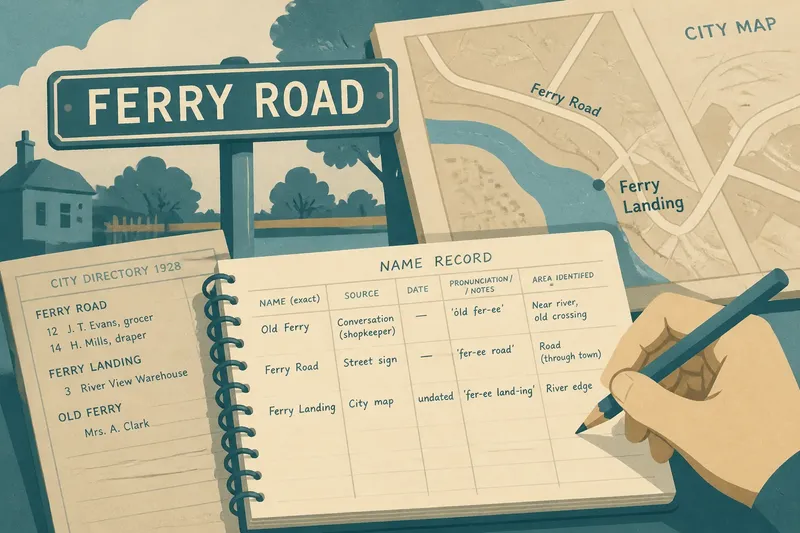
A place name can survive long after its spelling and everyday use have shifted. To read the older name under a new sign, compare how it appears on maps, street signs, directories and in local speech—and keep each version tied to its source. The differences can reveal a name’s path; none, by itself, proves what happened at the place.
Listen for the name
Start with what people call the place now. A spoken name may sound unlike its official spelling, or locals may use a shorter form that never appears on signage. Note the sound as well as the letters, and record who uses the name and for which spot.
That last detail matters. A name might refer to a street, a cluster of homes, a former crossroads or a larger district. Two speakers can use the same word for different areas without either being mistaken.
On a field walk, jot down the name as you hear it, then check nearby signs and address numbers. Don’t silently “correct” one form to match another: the mismatch is part of the evidence.
Compare written forms
Look for the name in materials made for different purposes. A current street sign gives the official form in use there; a city map may show a standardized spelling; a directory can preserve an older address label. Local library map collections and municipal archives may hold earlier maps or plans.
Write each form beside its source, along with any date or edition information printed on the item. A map’s publication date does not necessarily tell you when its labels were first adopted, so treat it as a dated appearance, not a birth certificate.
- Street signs show the name used for navigation today.
- Maps show how a publisher or agency labeled an area in that edition.
- Directories can connect a name to addresses, businesses or institutions.
- Local newspapers may preserve a spelling in ordinary prose, though their coverage can be uneven.
- Oral accounts can explain local pronunciation and usage, but may differ across households and generations.
Check whether a source labels the whole neighborhood or only a road, building or parcel. A label placed near a feature on a map may not clearly mark its exact extent.
Notice spelling shifts
Small changes can come from several ordinary processes: a clerk recording a spoken form, a mapmaker standardizing an unfamiliar word, or an agency choosing a consistent spelling for signs. Letters may be dropped, added or rearranged as people write a name they already know by ear.
Say you find “Miller’s Crossing” on an older map and “Millers Crossing” on a current sign. If the two labels point to the same road junction, the missing apostrophe suggests a change in written convention, not a proven change in the place’s origin or ownership.
Names can also be reshaped by pronunciation. A local form may compress several syllables, while an official version preserves a more formal spelling. Listen for the sound, but don’t infer a language, identity or meaning from resemblance alone; similar-looking words can have unrelated roots.
What can a name tell you?
A name is useful evidence of naming and use: it shows that someone applied a label, and a source can help establish when that form was recorded. Repeated appearances may suggest that the name stayed in circulation, though the exact area it described could have changed.
A name alone cannot establish who founded a settlement, who owned land, what language residents spoke, or why a feature received its label. Nor does an old-looking word prove that the place itself is ancient. Names migrate, get borrowed and can be reassigned to new roads or developments.
When a name seems to describe a feature—such as a mill, ferry or grove—treat that wording as a clue to investigate, not confirmation that the feature stood there. Look for independent records that identify the feature and connect it to a precise location.
Questions about old names?
Why do maps spell a name differently?
Maps may follow different spelling conventions, copy earlier labels or record a local pronunciation in writing. Compare editions and note the publisher; a variation may reflect the mapmaking process rather than a renamed place.
Does an old name prove a place is old?
No. A name can be transferred to a newer road or neighborhood, and an old spelling can remain in use after the feature it once described has disappeared. Seek separate evidence for the age of the place itself.
Which version should I use?
Use the official form when giving an address or directing someone, and identify local variants when discussing history or speech. If the name is disputed, say which source uses each form rather than presenting one as the only authentic version.
How can I check a name’s meaning?
Look for a reliable local place-name reference, archival material or a knowledgeable language specialist, and compare the proposed meaning with the recorded forms. A modern resemblance is not enough to establish an etymology.
Keep a small name record
A compact field note can make later comparisons much clearer. Record the location, exact spelling, source, date shown by that source, pronunciation if you heard it, and what area the name seemed to identify.
- Copy the spelling exactly, including spaces, punctuation and accents.
- Mark the source type, such as sign, map, directory or conversation.
- Note where the label sits in relation to visible streets or landmarks.
- Separate what the source states from what you infer.
- Leave uncertain meanings open rather than filling them in from guesswork.
For instance, imagine a walker hears “Old Ferry” from a shopkeeper, then sees “Ferry Road” on a sign and finds “Ferry Landing” on an undated map. The useful observation is that three forms are associated with nearby places; without a dated record tying them together, the walker should not claim they identify one exact site or establish when a crossing operated.
That distinction keeps a name’s story honest. The older name under a new sign is often easiest to understand as a trail of recorded forms and remembered sounds, with the gaps left visible.
When sharing your notes, attach each claim to the source that supports it. That simple habit lets another reader follow the name’s changes without mistaking a suggestive word for a settled history.